
Two scenarios from the technical report
Mike Weberstadt, in PPSA 2025, describes two applications of the NDT Global/TSC Subsea cable robot. The first examined two oil lines longer than the previous one. 1,2 It's a mile each with an almost vertical Razer and only access point. The wall was measured with acoustic resonation. In the second case, a locally tested R & D radios using AFFM and phased ultrasound bars were used.
These are examples of different control programmes on a common robotic platform. It is important to consider them separately: continuous measurement of thickness and sample surveys of connections do not provide the same set of pipeline data.
Why A return is More Than a Range
The maximum range of traffic is often the main commercial parameter of a robot. However, the determining factor may be a spare effort for return. The resistance to cable grows as it is removed, changes on the withdrawals and depends on the environment. The vertical section adds the weight of the machine and cable.
Therefore, a reasonable test programme considers the entire route in both directions. It is not enough to show movement on a short line. The most unfavourable combination of rotation, friction, mass and position of the measurement module shall be repeated. The proof of passage shall take into account the configuration of the fully assembled system, not just its traction part.
Cable helps and limits simultaneously
The cable connection allows data to be collected and the system to be monitored during operation. The operator may assess the signal quality before the passage is complete, stop movement or repeat the measurement. This is particularly valuable when access to the road pipeline and return to the site require a separate campaign.
At the same time, cable becomes a mechanical part of the survey. Its permissible loads, bends, interaction with edges and ability to extract under control should be taken into account. The presence of a cable does not in itself mean that it is guaranteed to evacuate. The return shall be a separate, verifiable function aligned with the robot device and the actual track.
The passivity and measurement shall be checked separately
The robot may successfully pass the withdrawal but lose the sensor orientation or acoustic contact. Therefore, the pass and quality measurement maps — Different documents. For each section, it is necessary to understand whether the data are obtained from the whole circle, whether the necessary sensitivity has been maintained and what areas have remained out of control.
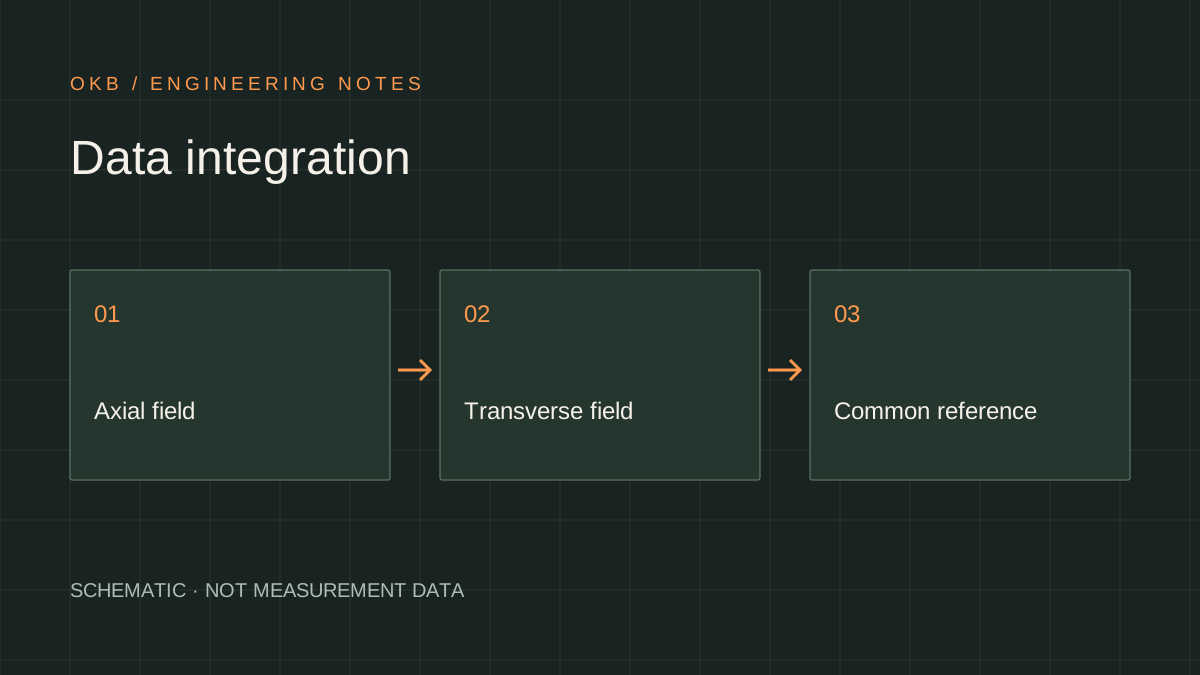
In a two-directed survey, the second passage helps to check reproducibility and close part of the pass. However, the mere integration of the two records does not guarantee completeness. Coordinates, duplication should be avoided and the path taken for each outcome should be shown, especially in areas of complex geometry.
Pollution cannot be considered a solved task forever
In the published case, the authors were able to conduct acoustic measurements in the presence of residual contamination. It does not follow that any line is capable of being monitored without preparation. The composition, thickness and distribution of the sediment, the properties of the liquid and the state of the internal surface are distinguished.
A preliminary examination helps to evaluate conditions and select representative tests. If the pollution changes significantly over time, only a clean sample test is not sufficient. It is useful to highlight areas of weakened signal and the reasons for their exclusion in the final data. Then the absence of a registered defect will not be misinterpreted as proof of a good wall in a bad measuring area.
Full review and local verification complement each other
The review measure allows for suspicious areas to be found over a long period. Local control adds details at selected locations, e.g. near weld. In such a combination, it is important to determine in advance how the detailed survey points are selected and what threats the review method can miss.
If local measurements are performed on only a few stitches, they cannot be extended to all connections of the line. The correct report contains a list of the sites tested, sensor orientation, size of the area surveyed and limitations. This allows for the use of detailed results as intended, while maintaining a clear boundary between established fact and assumption.
What the Reception stand should show
The cable installation shall be checked in a useful way when it includes the criteria observed: stability of motion, extraction force, cable protection and post-turn measurement quality. A simple video of successful travel does not replace recording these parameters. It is also important to indicate which conditions of the real object stand do not reproduce.
It is reasonable to check several load configurations and state after repetition. Change in the contact of the supports, heating of the drive or gradual damage to the casing may occur at a time. The result is a list of confirmed conditions and remaining restrictions. This is the document that links laboratory experience to a particular route and identifies what additional information is needed before an industrial survey.
Which makes the robotic complex mature.
Industrial maturity is determined by the harmonization of mechanics, measurements, management and data processing. A reliable traction platform without a quality coordinate will make it difficult to find the defect. A great sensor without a pass-through can't get the data. Rapid communication without quality control will only expedite the transmission of unusable recording.
A matrix is useful for engineering analysis: the route area, the expected difficulty, the method of verification, the measurement result and the backup solution. This structure helps to discuss a complex object in a substantive manner. It also separates real confirmation of the possibility from general assertion that a robot can examine "intra-passable pipelines".
Engineering output
Roboticization increases access, but requires separate proof of return, passability and quality of measurements. All local controls shall have transparent surface boundaries.
Sources and further reading
- PPSA Technical Report 2025open PDFNDT Global / TSC Subsea — Tethered Internal Crawler: Unlocking New Possibilities for Unpiggable Pipelines ↗
The article was originally written in Russian. It summarises the cited sources. For the original text and illustrations, consult the publications listed below.