
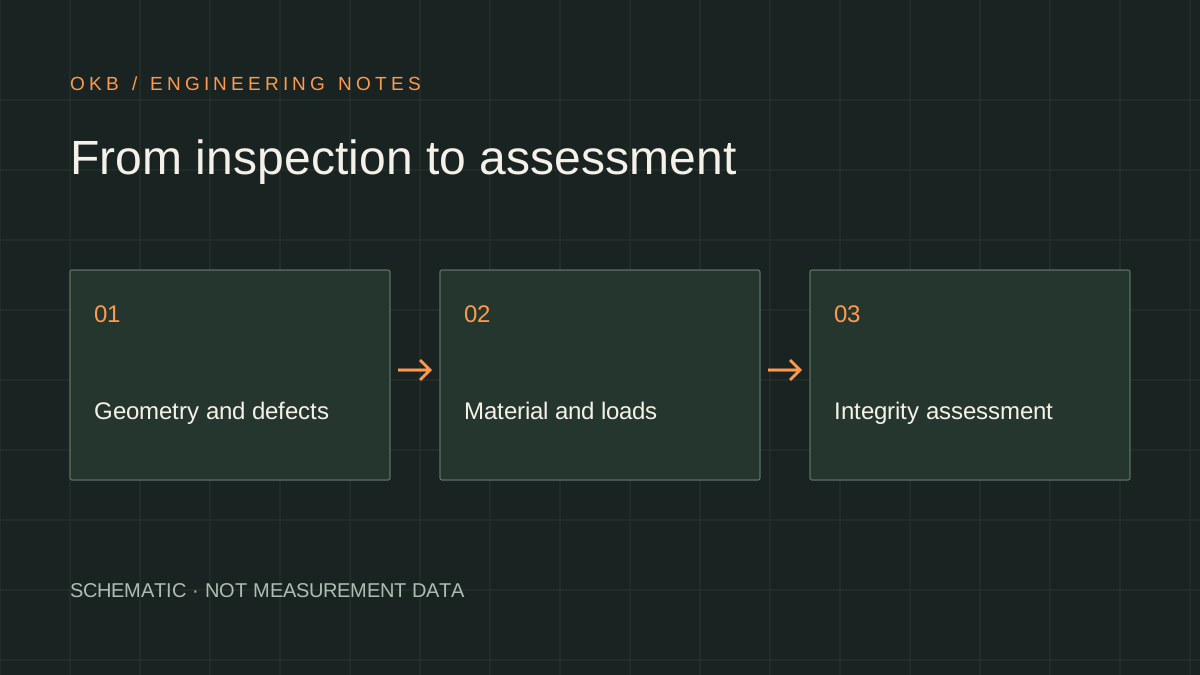
What the TDW Reviews
Chuck Harris ' 2012 PPSA report discusses the sharing of geometric and magnetic data in the assessment of mechanical damage. The author describes the different directions and levels of magnetization, as well as the combination of the elements for the prioritization of the dent. This is an approach that considers the shape of a pipe together with possible collateral damage.
We're looking at the physical logic of this association. The article does not reproduce the internal TDW ranking model or propose a universal formula for the admissibility of Mt. This requires specific object parameters and a confirmed assessment methodology.
The depth of the dent does not describe everything.
A narrow sharp dent and a wide smooth shape change may have the same maximum depth. But the surface curve, distribution of deformation and the interaction with welding will differ. Therefore, one percent reduction in diameter is not sufficient to fully describe the damage.
The geometry profile should be spatial in shape, not just extreme. The focus, length, number of local vertices and position regarding sutures are important. The derivatives of the profiles are sensitive to noise and measurement steps, so calculation of deformations requires a separate quality check of the reference geometry.
Related metal loss
Mechanical exposure may be accompanied by a bully or local wall loss. The geometric channel shows a change in shape, but it does not always determine the presence of such damage. The extra magnetic channel provides other information that needs to be compared by coordinates.
The convergence of the indications next to the drawing does not yet prove the interaction. The distance between the measuring sections of the inspection tool, the turning of the instrument and the accuracy of the odometer shall be taken into account. The combination error can either combine independent features or separate the physically bound dent and metal damage. Therefore, the reference model is part of the diagnostic output.
Magnetic properties and history of deformation
Mechanical deformation can change the magnetic response of the material. But the magnetic signal also depends on steel structure, magnetation and geometry. Therefore, an unusual response cannot be automatically converted to a specific voltage or hardness without appropriate calibration.
Different levels and directions of the field can help to separate the signs, but each channel has its own sensitivity and limitations. For interpretation, samples with known loading history and independent measurements are required. Otherwise, the engineer risks a correlation between signals for universal quantitative dependence that the raw data do not support.
Why Rerounding Makes Evaluation More difficult
After mechanical action, the shape of the pipe may be partially altered by pressure or by removal of the outer support leg. The current deepening does not necessarily fully reflect the greatest distortion in the past. So a moderate visible dent does not always mean a small load history.
It's no reason to think any shallow anomaly is dangerous. This is a basis for analysing additional features and conditions. If the profile has changed between surveys, pressure, environmental condition and measurement method should be checked. The differences in shape may be physical, but may arise from authorization and linkage.
The data integration must be explained
A good ranking system shows what signs have raised the priority of the site. The non-transparency score makes it difficult to verify and work with contradictions. It's good for an engineer to see geometry, magnetic indications, data quality and the basis of the association.
The absence of a sign in one channel should be interpreted with regard to its coating and sensitivity. If the measurement at the dent was incomplete, it would not be tantamount to a lack of an accompanying anomaly. The rules for the processing of passes must be clearly specified so that a certain conclusion does not appear where the data are least available.
Realistic damage test
The test programme shall include different shapes of the ointment, provisions for seam and a combination with metal loss. There are also areas that need to be free of mechanical damage, but with similar magnetic features. This not only allows for detection but also for false classification.
Independent profiles and the conditions for their acquisition are important for geometry. For the magnetic part — known magnetization configuration and contact quality. The comparison should be performed on the same basis. The verification of a separate channel is useful, but the resulting integration model requires an evaluation of itself on data not used in its settings.
OKB Engineering View
Geometric and magnetic inspection tools solve different but related measurement tasks. Coordinates, metadata and the preservation of the reference signals are particularly important for joint analysis. These requirements should be taken into account in the development of on-board electronics and software.
The TDW experience shows the value of several independent views on one injury. The editorial conclusion of OKB is that there is a need for an understandable data integration. It is useful to show the basis of priority in the interface: dent shape, adjacent magnetic features and the quality of their co-ordinate combination. The expert may then verify which factor determined the final assessment of the site.
Engineering output
The dent is assessed by shape, associated characteristics and the quality of their combination; one depth does not describe the entire mechanical situation.
Sources and further reading
- PPSA Technical Report 2012; open PDFChuck Harris, T.D. Williamson (TDW) — Assessing Mechanical Damage Using Multiple Data Sets in Inline Inspection ↗
The article was originally written in Russian. It summarises the cited sources. For the original text and illustrations, consult the publications listed below.