
Subject matter
The 2021 Baker Huges examines the sharing of axial and bending deformation data. The authors link the measured state to an assessment of the disformation capacity of the site, taking into account the characteristics of the pipe, welds and the damage. The main idea is to compare actual exposure and available stock, not ranking only by bending.
It's a useful basis for talking about the tense-deformed state. However, geometry measurement, deformation assessment and stress calculation remain different operations. The self-review below explains the underlying data that binds these transactions and why the only number in the report does not replace the engineering model.
What shows the curve of the axis
If the pipe bends, one side of its cross section is extended and the opposite is reduced. The measured curve of the axle allows the bending component to be evaluated within the accepted model. For a thin wall pipe, the characteristic scale of such a component is associated with the production of curvature and the distance from the neutral axis.
But the pipe itself can be stretched or compressed along the axis at the same time. This component does not have to create a marked curve. Therefore, a flat area on the plan is not necessarily free from longitudinal effects. In addition, the initial mounting bend and subsequent change in position should be distinguished: information on the original form or a reasonable replacement of such information is needed to estimate the increment.
Why the distortion isn't equal to tension
Deformation describes relative size change, voltage — The internal effort, which is taken to the square. In a simple viscosal model, they are bound by the properties of the material but may have a plastic current, residual state after manufacture and temperature effects in the actual tube. Direct multiplication of the measured change by one module does not always describe the required value.
The result should be clearly stated in the report: geometrical bending, curved between surveys or stress calculations for given assumptions. If these names are mixed, the user can accept a model estimate for direct measurement. Traceability begins with the preservation of the source channels and a description of the transformation of each channel into an engineering measure.
Load and required movement
Pressure and movement of the ground affect the pipe differently. When the base is changed, the design has to follow the intended shift by reallocating the length effort. The site may have a significant deformation, not described by one simple stress limit. For such an event, it is important to understand the nature of the retention and the length of the exposure zone.
In the self-assessment, it is useful to first formulate a scenario: precipitation, landslides, loss of support or temperature displacement. Then choose a model that fits the scenario. An attempt to calculate the reserve without defining the mechanism can give an exact arithmetical but not a meaningful number. The result shall include sensitivity to unknown securing conditions and soil properties.
The ability of the site to deform depends on what
Two adjacent areas with the same recorded deformation may have different significance for integrity. In one case, the limiting element will be welding, in another — Local metal loss, third — The tendency of the wall to local loss of stability during compression. Therefore, the supply of stretch and compression is considered separately.
The calculation requires agreed material, geometry, stitching and defects. The missing parameter cannot be easily replaced by a favourable assumption. It's better to show the range of results for reasonable scenarios and determine which additional measurement would most likely reduce uncertainty. This translates the survey from data accumulation to a focused clarification of the engineering solution.
Convergence of measurements on the track
The axial canal, inertial record and faults may have different coordinate errors. It is particularly important to correctly combine the local maximum deformation with the weld or corrosion zone. An error at a short distance can change the selected maximum state model.
The combination should be checked against sustainable benchmarks and the result stored with an assessment of accuracy. Reruns are useful for determining change, but require a reconciliation of pressure, temperature and processing algorithm. If the program version has changed, some of the difference may come from processing rather than pipe. Dynamic observation requires recalculation rules and a raw data archive.
How to make a conclusion fit for decision
The report should show not only the most loaded places but also the basis for ranking them. For each relevant site, it is useful to separate the observed topic, the exposure model, the assessment of the ability and the information that is not yet available. The operator then sees where the survey is needed and where the calculation scheme is clarified.
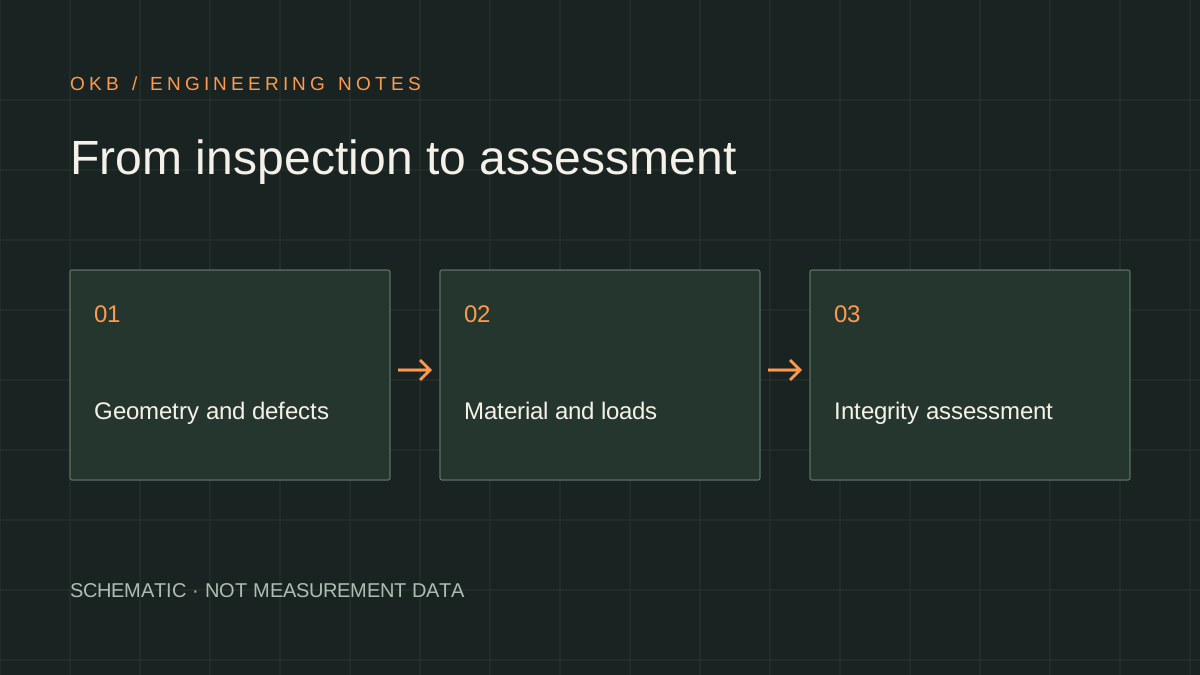
For OKB, the engineering interest is to harmonize sensors and program processing so that measurements remain relevant in the next stages of analysis. The geometry channel describes the shape, and the transition to a tense deformed state requires additional material, load and fixation data. It is useful to keep these input parameters separate from measurements so that the calculation can be repeated when the assumptions change.
Engineering output
The distortion evaluation becomes meaningful after the measurements are combined with the material, defects and effects model. One limit for the whole road hides these differences.
Sources and further reading
- PPSA Technical Report 2021; open full textInessa Yablonskikh, Mohamed ElSeify, Jane Dawson, Baker Hughes — Strain demand and capacity assessment based on in line inspection of axial and bending strains ↗
The article was originally written in Russian. It summarises the cited sources. For the original text and illustrations, consult the publications listed below.