
Send point: Publication of Baker Hughes
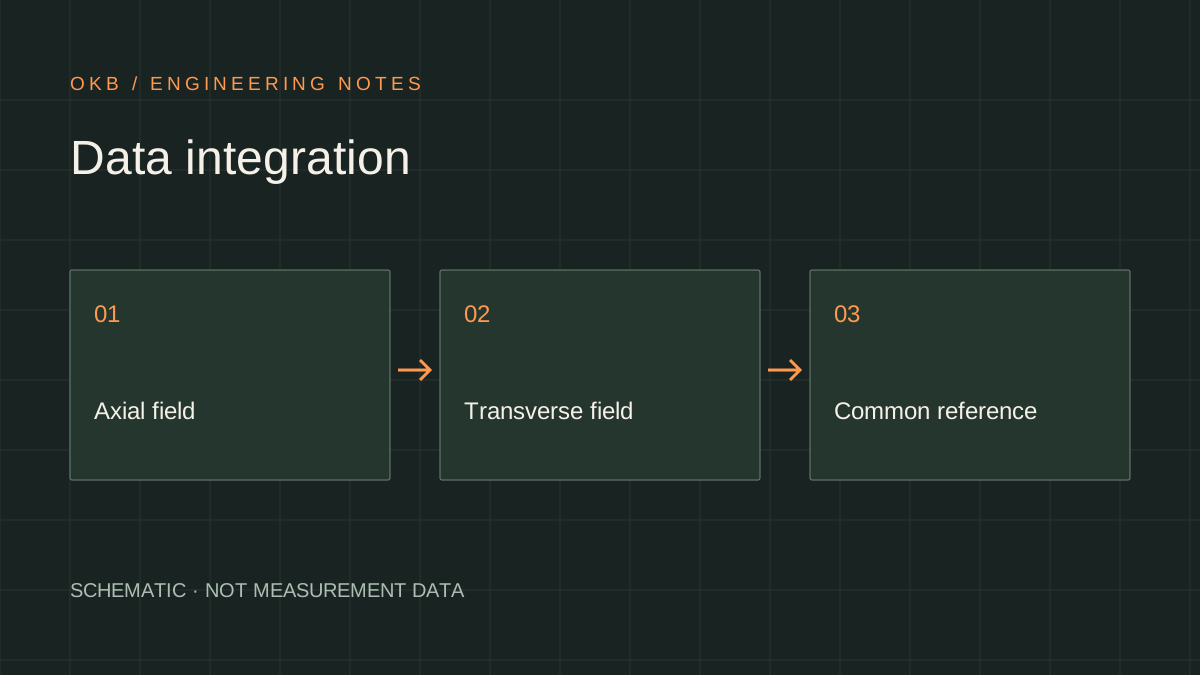
Philip English, Stuart Clauston and Anthony Tindall in the PPSA report 2025 consider accuracy enhancement MFL The project is designed to provide a framework for the development of knowledge and results monitoring. Three-way magnetic data, a description of the form of corrosion, individual estimates of error and the relationship to re-examination are discussed. Central idea of publication — Check the model as actual data are accumulated.
Key issues in such development — The source of reference, new data validation and the sustainability of individual error estimates. We'll figure out how to link algorithm learning with practical assessment of magnetic control quality.
The magnetic signal is not a direct photograph of the wall
The field of dispersion depends on the form of metal loss, the direction of magnetation, the properties of steel and the position of the sensor. The task of restoring depth is therefore mixed. Different combinations of geometry and registration conditions can provide similar responses. The model that is trained uses patterns in data but does not automatically eliminate physical ambiguity.
For practical application, the area in which the model is checked must be described: wall thickness, types of defects, speed and sensor configuration. When you go out to these conditions, it's more important to find a lack of evidence for the evaluation than to give a beautiful three-dimensional profile with unreasonable precision.
The Master Standard also has an error.
Field laser scans or post-mortem measurement are usually perceived as the truth for learning. However, surface preparation, reference thickness determination, access to the bottom of the ulcer and co-ordinate combination affect the reference result. If these errors are not taken into account, part of their model will be perceived as a property of magnetic method.
Each reference should therefore have its own description of origin. It is useful to store the date, cleaning method, reference surface grid and fault code. Unharmonized markings of different contractors may limit the quality of training more than choice of algorithm architecture. Data production here is an engineering exercise, not a supporting formality.
Defects have the same depth, different certainty
The wide, smooth loss of metal and narrow deep ulcer may have the same maximum depth but differ in the sustainability of the assessment. The results are influenced by the location of sensors, the shape of the paintings and the surrounding anomalies. Therefore, a common error for a large group of objects sometimes conceals significant differences.
Individual uncertainty assessment is useful if tested on independent data. It is necessary to show how often true dimensions are found in the declared interval and whether this property remains for complex forms. A narrow interval is not an improvement in itself: it must be consistent with the actual reproducibility of measurements.
It's not just the average error that needs to be checked.
The average difference may be small when positive and negative errors are mutually compensated. Systematic underdevelopment and rare large variations are particularly important for the assessment of the state. It is therefore useful to analyse the distribution of errors, the relationship between depth and the characteristics of individual groups of defects.
Separately, objects that are not reported at all should be considered. The size checks on the only anomalies found do not indicate any pass. The complete quality control programme links detection, correct classification and size determination by retaining separate criteria for each step and a clear statistical base.
The update of the algorithm affects pipeline history
In the case of a re-examination, differences in estimates may arise from increased corrosion, changes in instrument or new processing. If these causes are not separated, the program can show a perceived acceleration or deceleration of destruction. Comparison of completed tables without reference signals is often not sufficient.
One useful approach — Re-process comparable records in a harmonized manner and check spatial balance. The initial results should be retained and the changes explained. The editing of history without a version log prevents the owner from understanding what decisions were made on the basis of information available at that time.
As you can see, the change in quality on the new line
It is useful to monitor the distribution of input signs: signal levels, speed, thickness and proportion of unusual forms. If they are clearly different from the verification base, automatic application of old statistics requires caution. This does not prove the model wrong, but it shows that further analysis is needed.
The controls should include output signs: a sharp change in the proportion of deep objects or too narrow intervals may result from treatment. To determine the reasons, they select representative records and check the entire chain from registration to evaluation. Such an audit would be more useful than a model setting just to match the final table with the expected corrosion picture.
Continuous verification as part of the measurement system
Once implemented, feedback from field audits is required. The post-opening sites are often chosen according to the level of risk and do not represent the totality of anomalies. If you forget this shift, the statistics will only describe selected complex objects.
The editorial conclusion of OKB is that the algorithm should be read in conjunction with the verification procedure. The credibility is enhanced when the scope, origin of reference, processing version and reasons for exceptions are known. This is the traceability that allows for new computing methods to be used without replacing measurement confidence with impressive visualization.
Engineering output
The I.I. is useful for interpreting MFL when its estimates are verified by independent measurements and accompanied by reasonable uncertainty. The change in the model must be seen in the history of the data.
Sources and further reading
- PPSA Technical Report 2025open PDFBaker Hughes — Optimising Magnetic Flux Leakage Inspection Accuracy through AI Techniques and Ongoing Performance Tracking ↗
The article was originally written in Russian. It summarises the cited sources. For the original text and illustrations, consult the publications listed below.