
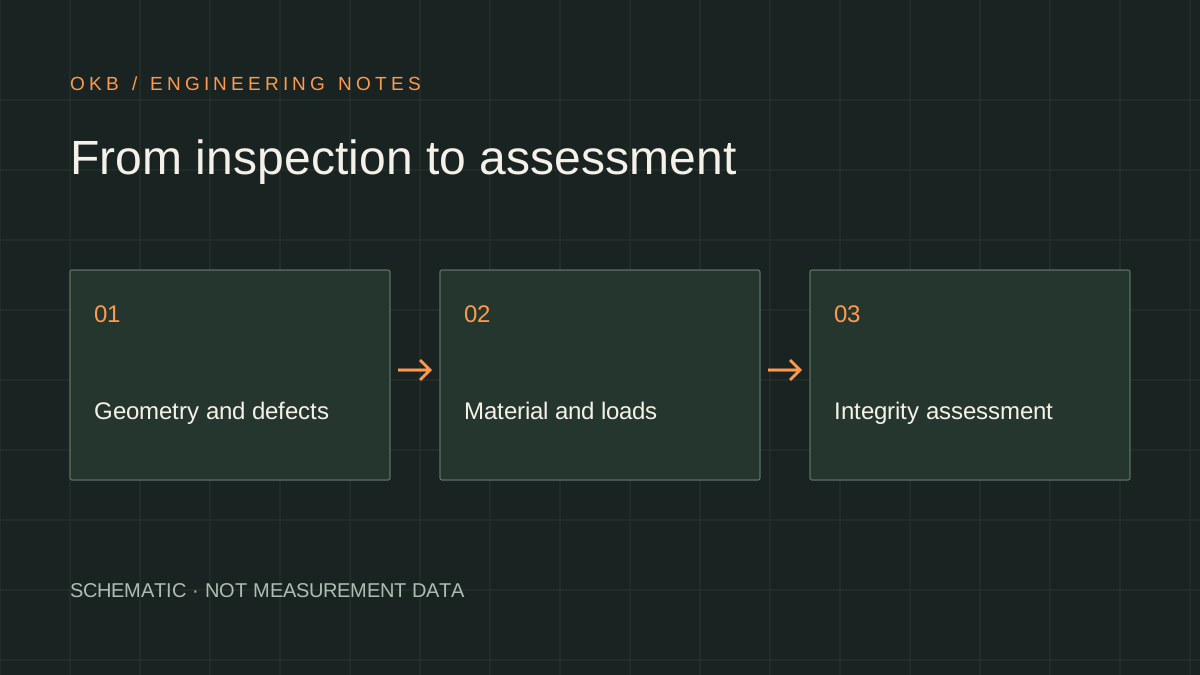
What was examined in the published case
Arva Westbyo from Equinor and Thomas Mrugala from NDT Global in PPSA material 2022 describe the survey 720- a metre section of flexible razer and end connections. The two-directed ultrasonic system was used for access. The task included measuring the distances between the internal framework elements and assessing their position near the end nodes. The authors report that no injuries were found under this programme.
The central measurement task here — The geometry of the inner framework and its position near the end nodes. Consider how the periodic structure helps to analyse what requirements are required for authorization and how to compare the two directions of passage.
Flexible pipe is different from monolithial steel wall
The multilayered structure contains elements with different functions. The internal frame, sealing layers and force elements cannot be considered as one homogeneous wall. The state of the accessible internal surface provides an important but limited part of the information about the entire system.
Therefore, a target-specific damage mechanism must be identified before selecting the instrument. Control of the movement of the frame answers one question, assessment of the state of the force layers — On the other side. The presence of a qualitative image of the inner surface does not prove the integrity of all hidden elements. This boundary must be visible in the program and final report.
Periodical structure creates measurement capability
Repeated components of the framework allow for analysis of their mutual location. A local step change may indicate a different geometric state, but it still requires interpretation. Consideration shall be given to design, working curve and permissible changes in operation.
It is useful to consider not only distance but also length and circle distribution. The steady change in the group of elements is different from the single release due to signal quality. The algorithm should therefore maintain the initial observations and allow for verification of how the boundaries of repeat parts are identified.
The resolution and accuracy have different meanings
The registration step shows how often the system gets the results. Accuracy describes the proximity of the estimate to the actual value. A small interval between points does not guarantee an equally small error in determining the position of the detail. The results are influenced by the breadth of response, orientation and processing.
The specification should distinguish between spatial discreteity, sensitivity to changes and confirmed dimensional error. This is particularly important for periodic structures: interpolation can show a smooth movement of the boundary between accounts, but such improvement requires self-checking. The number of digits after the decimal point shall not exceed the actual base of measurement.
End knot requires local review
The transition between the flexible part and the end connection has its own geometry and securing conditions. The change in the structure near this node may be important, but assessment requires a baseline or other reasonable reference. Without a base, it is difficult to distinguish between permissible design and displacement.
It is therefore useful to retain the results of the initial survey, assembly data and coordinates of characteristic surfaces. The subsequent comparison shall take into account the changing loading conditions. If the original documentation was incomplete, it should be reflected as a limitation on interpretation rather than a substitute for the assumption of which node should have been.
Two Directions — Reproducibility testing capability
The reverse passage can provide additional insight into the same area and help to identify measurement instability. However, the signal may depend on the direction, position of the sensor and traffic conditions. So the records need to be reconciled and the differences investigated before we can average them.
Particularly useful are areas where one passage has given a weak response and another — A sure dimension. The final map should show which data set was used. If both passages are not of sufficient quality, the absence of result shall remain visible. Automatic filling of such a zone gives the false impression of continuous verified control.
How to prepare data for subsequent observation
The first survey can be the basis for future comparison if coordinates, mode, reference signals and rules for the selection of components are maintained. One final table of the mid-step does not allow local changes to be restored. The archive should therefore include a presentation of the surface and quality information for each site.
In the case of re-examination, it is useful to first check the steady zones and evaluate the overall shift of the reference. Then analyse local changes, taking into account the functioning of the Ryser. This makes it possible to distinguish potential development from differences in conditions and processing. This approach makes the initial recording a useful engineering asset even when no significant damage is detected during the first control.
From measurement of the framework to system evaluation
Internal geometry data are becoming part of a broader assessment, together with the operational history and other design elements. Moving to a conclusion on the resource requires a model of damage and an understanding of what threats the survey actually covers. One well-off cannot replace the entire integrity program.
For the OKB engineering approach, this case is useful for a precise task: measuring the specific topic, checking its reproducibility and transmitting the result to the design specialist. The confidence is achieved by a clear boundary of possibilities. The more difficult the object is, the more important it is to avoid a general conclusion that is larger than the actual data.
Engineering output
The measurement of the inner framework allows for the evaluation of certain geometrical signs of a flexible Ryser. It is not an automatic control of all layers and mechanisms of damage.
Sources and further reading
- PPSA Technical Report 2022open PDFEquinor / NDT Global — Bi-directional High-resolution Inspection of a Subsea Flexible Riser Pipeline ↗
The article was originally written in Russian. It summarises the cited sources. For the original text and illustrations, consult the publications listed below.