
What's firsthand
The 2014 Baker Huges and Noble Energy report focused on the preparation and survey of a long deep-sea gas transport system. It combines technical and organizational issues, measurement choices and data requirements. The annex shows separately that the various characteristics of a pipe are available to identify a particular channel.
For engineering review, the key question is what information should be stored at the beginning of the life of the facility so that subsequent surveys distinguish between damage and original construction and installation.
The baseline does not mean ideal
The new line may contain permissible variations in geometry, welding characteristics and local changes in thickness. The primary inspection shall record these signs, but shall not be based on the absence of anomalies in advance. Otherwise, the only reason that an unusual signal risks being excluded is because the object has recently been built.
It is useful to separate the identification of a constructive feature from the assessment of its acceptability. The instrument provides the observed sign and its coordinates, while the engineering evaluation uses design data and criteria. This separation helps to avoid a situation where the base looks perfect only through excessive filtering.
Relationship to production data
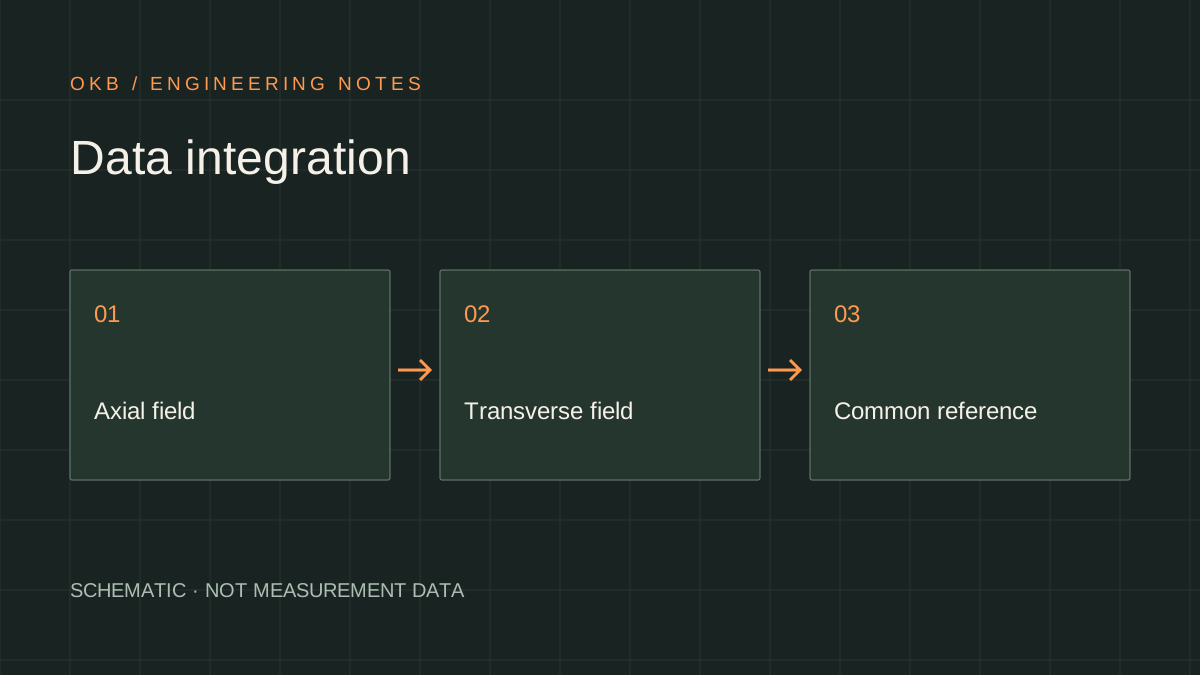
The plant measurements, pipe passports and installation documentation provide an important context but often use another reference system and marking. For future analysis, a correlation between the pipe sections, welds and the internal tube record distance must be established.
This comparison is useful as long as building information is available. In a few years, the recovery of identifiers may be more difficult to measure. The actual thickness of the passport notation should not be replaced by a reference: factory tolerance and spatial heterogeneity of the wall may affect the estimation of relative metal loss.
Preparation affects observation
The environment, residual pollution and internal surface state determine the quality of contact and stability of traffic. Therefore, the sequence of preparation and measurement should be agreed. Successful completion of one-test cleanup does not always mean readiness for the physical method chosen.
For example, the evaluation of the waste removed and the assessment of the suitability of the acoustic signal answer different questions. Separate indicators of measurement readiness and rules of action for incomplete data are needed. Otherwise, an organizationally completed operation may leave gaps that will only be discovered in a subsequent comparison.
A map of opportunities instead of a general promise
The thickness, geometry and fracture search have different applications. The primary inspection should be accompanied by a list of observed signs and restrictions. The absence of a record of a particular type of defect does not prove that it is missing unless the channel was intended for such a task.
It is useful to link the expected threats in advance with the required measurements. For each, quality criteria, spatial coating and validation conditions shall be specified. This map becomes part of the original base of an object and helps a future analyst understand what changes can really be measured by old recording and which require new methods.
Long mission and sustainability of recording
A long sea run requires energy, memory, tightness and mechanical resources. The nominal time calculation is not sufficient: a reserve for possible delays and regime change is required. Equally important is the integrity of the coordinate registration at the entire distance.
The test programme shall verify the long-term joint operation of the subsystems. Separately operated storage and power can behave differently at total load and temperature. It is useful to keep the service telemetry in the data so that when the instrument is received, it can explain the local deterioration of the signal and determine its boundaries.
Archiving suitable for the next inspection
The reference base should include not only the final report but also data needed for re-examination: channels, coordinates, configuration, processing versions and quality map. It is important to maintain units of measurement and field definitions so that they are not recovered indirectly after years.
Post-removement reading control and testing are useful for the sustainability of the archive. The format should allow the new results to be linked to old ones without dependent on a single image or outmoded workplace. This is a programme engineering task that directly affects the value of an expensive initial survey.
OKB Engineering View
In the development of diagnostic equipment, the reference measurement should be considered as the beginning of a long history of data. Therefore, the on-board system, analytical software and documentation should use agreed identifiers and understandable quality status.
The marine project in the publication shows the breadth of this task: primary survey data should remain available for later matching on seams and other sustainable pipe features. Our conclusion relates to architecture: a reliable instrument must leave behind a verifiable record suitable for subsequent comparison. The result then remains valid after the specific operation and the software tools have been changed.
Engineering output
The primary inspection is valuable in creating a reliable and reproducible point of account for the entire further history of the object.
Sources and further reading
- PPSA Technical Report 2014; open PDFBob Snodgrass and Co-authors, Baker Huges / Noble Energy — Managing Technical and Logistical Challenges on a Deepwater Gas Field ↗
The article was originally written in Russian. It summarises the cited sources. For the original text and illustrations, consult the publications listed below.