
Task from 3P Services
Johannes Koyter, in PPSA 2023, describes the survey of a sea-gas pipeline with sediments that has prevented the distinction between pollution and metal loss. After the line was prepared, a combination of GEO, MFL and additional magnetic channels were used with different locations relative to the wall. This allowed authors to better share interpretation scenarios. The publication clearly indicates that the operator was still considering checking the anomalies.
The source thus contains experience in data acquisition and interpretation, but not complete independent confirmation of all dimensions. We then consider why the combination of channels is useful and what restrictions it continues to have.
One signal may have several reasons
If the sensor has gone off the wall because of contamination, its magnetic response changes. The change in the field may also involve loss of metal. When both factors are present at the same time, simple interpretation of amplitude becomes particularly unreliable.
The geometric lever shows the surface to which it relates, but this surface may be sedimented rather than steel. Therefore, a reduction in measured passage does not necessarily imply a deformation of the pipe. The main objective of the combined approach — To obtain several observations that are sensitive to possible causes and to verify their mutual consistency.
The independence of channels is more important than the number of channels
Adding sensors is useful when they actually provide new information. Two identical channels with a common source of error may increase repeatability, but not eliminate ambiguity. A more substantive combination, where one channel follows the contact surface and another has different conditions for interaction with the wall.
The analysis must be based on the physical meaning of each signal. Most channels cannot simply vote because they can depend on each other. It is more useful to build the verified hypotheses: what combination is expected with pure corrosion, with postponement and their joint presence, and then to look for inconsistencies.
Coordinated combination determines the value of the combination
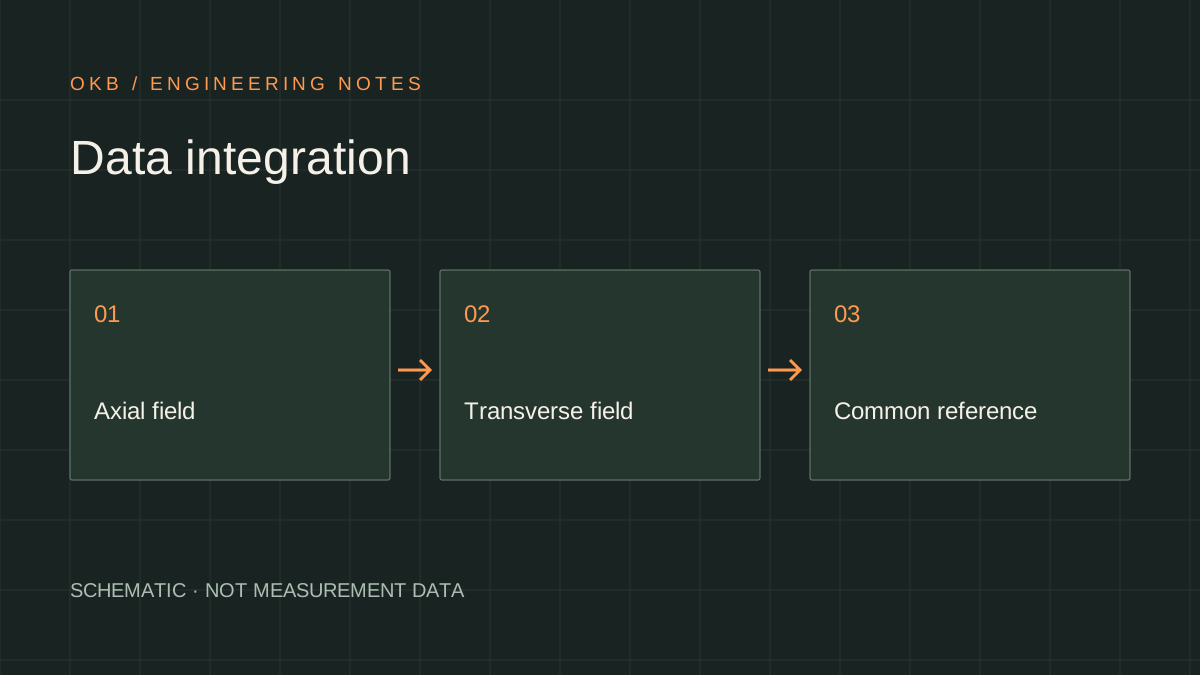
The measurement modules are located in different locations. When the speed changes and rotations occur, the same object is recorded with different time delays. If the channels are rough, the deposit in one place may be mistakenly linked to the loss of metal near the site.
Therefore, a common longitudinal and district reference is required. Checking for persistent features helps to evaluate the quality of combination. The final analysis is useful to show the range of uncertainty in the coordinate, especially when it comes to small ulcers. The combined system becomes informative only after it is proven that the same areas are actually compared.
Cleaning remains part of metrology
Additional channels can help to recognize the effects of pollution, but this does not make the preparation of a line unnecessary. Depositions can mechanically restrict movement, damage elements and create areas where no method provides sufficient information. Therefore, data cleaning and processing are complementary.
The readiness criterion should preferably be linked to the measurement task: permissible separation, contact status and signal quality. If residual contamination persists, its effects should be reflected in the reporting limitations. The phrase "retroactivity detected" requires more justification than the mere existence of an unusual magnetic response.
How to Check Classification
Verification should cover different scenarios, including the joint presence of pollution and metal losses. If you choose only the most obvious objects to be opened, you can get a good match without finding out the quality of the method in complex cases. Representative groups and transparent criteria for their selection are needed.
It is useful to evaluate separately the type of anomaly and the accuracy of the dimensions. The correctly recognized corrosion can be measured wrong; the exact internal profile can be a sediment. This separation helps to understand which part of the system should be improved: physical channel, combination or interpretation algorithm.
How to View Conflicting Channels
If the geometric and magnetic channels are not in line with the expected scenario, the facility should be left open for further consideration. It is not necessary to force one of the pre-defined categories to be chosen. There may be unusual sediment composition, a combination error, loss of contact or a combination of several features.
It is useful to retain alternative explanations and indicate what kind of observation will allow them to be separated. This could be a re-entry, another physical method or field verification. This work with uncertainty increases the value of the report: the subsequent specialist receives not only a mark but also an understandable verification plan based on what is missing from the available data.
From signal map to engineering output
The meaningful report should maintain a distinction between established fact, the most likely interpretation and the uncertainty zone. For each significant object, it is useful to see the source channels and the basis for the classification. Then a follow-up field check may clarify the model, not simply confirm or refute the final mark.
For the equipment developer, this example shows the value of a harmonized measurement architecture. Geometry, magnetic response and contact conditions are a common task. The professional description of the complex should explain how the ambiguity of each channel is corrected and under what conditions the combination still requires further testing.
Engineering output
The combination of channels helps to separate sediment and metal loss, if their physics and coordinate are understood. Field verification remains a separate stage of proof.
Sources and further reading
- PPSA Technical Report 2023open PDF3P Services — Cleaning & ILI of Heavy Wall Subsea Pipeline with Improved Differentiation between Debris and Corrosion ↗
The article was originally written in Russian. It summarises the cited sources. For the original text and illustrations, consult the publications listed below.