
NDT Global Work Item
The 2019 publication examines the limitations of traditional impulse-echo control to crack complex orientation. The authors discuss additional reflectance features and sensor configuration that allow for better removal of inclined and curved cracks. Modelling and testing used in technology development are described.
The historical limitations of the former instruments in the report should not be considered to be the characteristics of all modern systems. Here we are interested in the general principle: the amplitude depends not only on the extent of the damage, but also on the geometry of acoustic interaction. Lower — A self-explanatory explanation of how this affects the design of the measuring complex and the assessment of reliability.
Orientation changes the way reflection is done
The ultrasound beam interacts with the surface of the defect at a certain angle. If the surface is inclined, the reflected energy can go away from the receiver. So a slight change of orientation can make the amplitude more powerful than a marked change in depth.
This is particularly important when trying to rank defects only by the brightness of the image. A weak signal doesn't always mean a small object, but a strong one. — Big. Interpretation requires knowing the direction of the exciter and possible ways of spreading. Additional measurement points help to distinguish size and orientation, but increase the requirements for synchronicization, spatial convergence and models for each observed response.
Artificial incision and real crack
The calibration incision is acceptable because it has a known geometry and is repeated in the test. The real damage can be curled, a deep direction changed and there is an irregular disclosure. Therefore, the confirmation on a simple sample is a necessary step but does not complete the test of a complex class.
It is useful to build the program in a sequence: simple geometry for physics testing, more complex samples for carrying capacity testing and real defects with independent research. At each stage, a limited number of factors change. If you use an unknown complex crack immediately, it is difficult to determine the cause of the discrepancy. This sequence allows the model to be improved in a meaningful way, rather than being adjusted to a separate image.
Several signals from one object
One defect can create several reflections of different origins. Their temporary position and dependence on the direction of observation may contain more information than the maximum amplitude. However, the automatic integration of these signals requires verification, otherwise neighbouring objects can be mistakenly assumed as one.
It's good to keep a clear theory of response in the algorithm. Then the analyst sees why the system chose a certain geometry. If part of the expected signals are missing, the output should take this into account and not complete the object without a mark. Visualization with an ideal continuous line can hide that several of its sections are interpolated between rare observations.
Detect and determine depth
Sometimes a stable difference from the background is sufficient to detect. The determination of depth requires greater knowledge: the relationship of the measured topic to the size and the assessment of the impact of other parameters. Therefore, the statement of cracks does not imply equal reliable measurement of their depth across the range.
The characteristics should separately disclose the minimum object to be discovered and the area where the quantification is confirmed. A complex orientation may require another algorithm or a wider interval. It's not a lack of design, but a reflection of the physics of the task. Without such separation, the user can apply a number from the report more precisely than the original measurements allow.
How to Check Model
The calculation of wave spread helps explain the mechanism, but its acceptance of one experiment does not prove universality. The variations in angle, thickness, defect shape, surface state and acoustic contact are important. For each combination, you need to understand what parameters are measured and what are assumed.
The independent definition of the actual form of damage is particularly valuable in complex cracks. It not only makes it possible to verify the maximum depth but also the reasons for individual reactions. The check should be performed on data not used for settings. Otherwise, the exact match may be the result of learning on a particular sample rather than the persistent properties of the method at a new object.
Engineering interest for OKB
For the developer, the article shows why the sensor node and algorithm should be created together. The extra channel is useful if it removes certain ambiguity. A simple increase in the number of similar signals may complicate the equipment without adding new information.
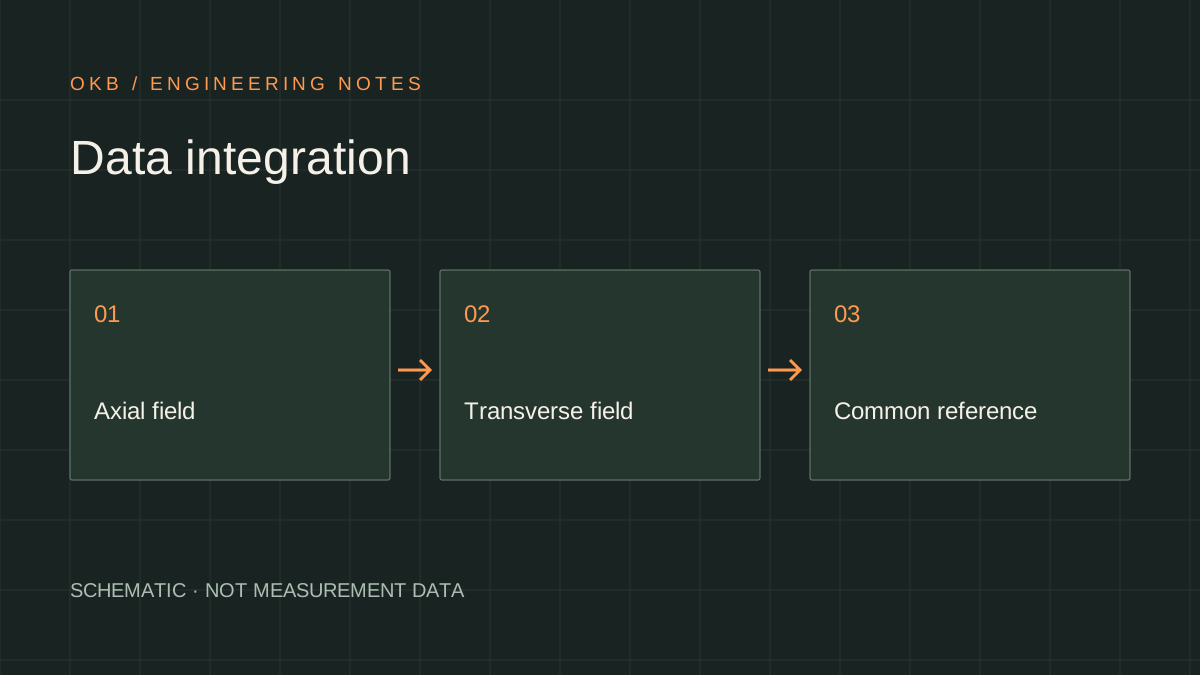
The OKB version considers this approach important for any multichannel system. First, they define what parameters of an object are mixed in the current measurement and then choose independent observation to separate them. In selecting the additional direction of pronunciation, it is useful to assess whether it changes inclination sensitivity and depth separately. The verification of a series of samples with independent changes to these parameters helps to see whether the new channel is really eliminating initial ambiguity.
Engineering output
For a complex crack, the size and orientation are interlocked in the signal. The reliability of observations and independent verification of the form of defect increases the physical combination of observations.
Sources and further reading
- PPSA Technical Report 2019; open full textNDT Global — Complex crack geometries: How to detect and accurately size them ↗
The article was originally written in Russian. It summarises the cited sources. For the original text and illustrations, consult the publications listed below.