
What they studied at NDT Global
In a PPSA 2023, NDT Global experts compared three previous magnetic sealine surveys with later ultrasonic measurements of the wall. The chains of ulcer and long longitudinal corrosion were considered. The authors show how detailed topography helps to describe the overall injury profile and produce data for load capacity assessment.
This is a comparison of specific surveys carried out at different times. It cannot be turned into evidence of the overall superiority of an ultrasound over MFL. We will then consider the separate methodological questions: what exactly should be compared, how to choose the basic thickness and why the form of damage is important for calculation.
Local ulcers and long drowning are building up
The pipe may contain a wide area of reduced thickness and inside — Deeper local ulcers. If the ulcer depth is taken from the local background, one number is obtained; if the reference thickness of the pipe — The other one. Both numbers can be correct in their system of counting, but answer different questions.
So the report must clearly define the basic thickness. It is particularly dangerous to compare the percentage of metal loss without checking the denominator. It is useful to maintain absolute residual thickness and a description of the reference profile for engineering evaluation. This restores the meaning of the value and avoids false discrepancies between methods.
The topography contains more than the table of defects
The table usually describes an object of length, width and maximum depth. This form is convenient for searching and sorting, but it may lose information about the links between ulcers, long channels and depth changes along the pipe. For some of the tasks to be calculated, these are the details that determine the result.
The surface map allows for longitudinal sections to be selected and the correlation of damage assessed. However, the grid density should be consistent with the actual resolution of the instrument. Interpolation creates a smooth image, but not new dimensions. Therefore, it is desirable to keep the reference points, omissions and surface construction rules together with the calculation.
The comparison of methods begins with general geometry
MFL and ultrasound form different physical observations. One method interprets the magnetic field, the other uses acoustic signals. Their reports may combine neighbouring features differently and ask for the boundaries of an object. A direct comparison of lines with similar kilometer is therefore not enough.
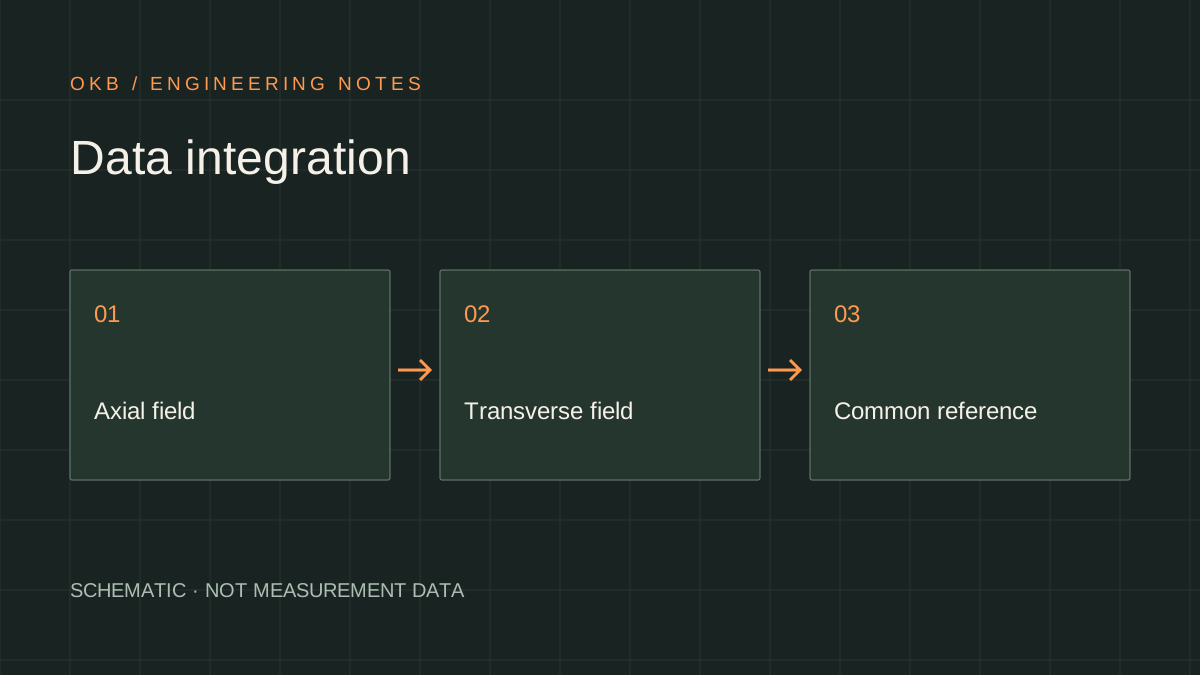
First, it is necessary to establish the alignment of sections, seams and orientation along the circle. Then agree on the basic thickness and grouping rules. Only then can differences of size be discussed. If surveys are divided by time, possible real corrosion development is added to the methodological differences which cannot be automatically attributed to the error of one instrument.
The measuring surface shall be appropriate to the calculation model
The calculation method may require a longitudinal profile of the minimum residual thickness, a description of the individual areas or another way to present the damage. These data do not always coincide with what is convenient to display in the diagnostic interface. Therefore, the preparation of the calculation entrance should be a clear step.
It is useful to document which points are included in the profile, how passes are handled and where the boundary of mutually reinforcing damage passes. The result of the calculation may change when the grouping rules are changed. The sensitivity analysis helps to determine whether the solution is due to actual geometry or technical settings for converting a map into a simplified description.
Long section requires systematic review
When damage covers several pipe sections, the weakest part may not be sufficient to fully describe the risk. The number and location of the sites, the distribution of uncertainty and the possible commonality of the corrosion mechanism become significant. It is not possible to sum up local figures mechanically without the selected model.
The system evaluation should explain what events and relationships are being considered. The overall cause of damage may be linked to neighbouring areas, and the errors of one survey may be correlated. Therefore, the calculation at the line level requires not only detailed topography but also a clear description of statistical assumptions.
How to keep the details on the map
Exporting the surface to a larger grid could hide a narrow minimum thickness. The choice of averaging instead of the minimum value also changes the meaning of the data. Therefore, the transmission format should describe the size of the cell and the rule of filling it, not just the units of measurement.
It is useful to keep the reference map near the calculation and check several characteristic sites after conversion. Special attention is needed to deep local ulcers inside the long drowning. The control of conversion is as important as the test of measurement itself: even a quality record loses its engineering value if the intermediate format does not notice the exact characteristics on which the calculation depends.
What's important is to communicate between diagnosis and calculation
The most useful set includes baseline measurements, quality map, base thickness, reference and object formation rules. The final table remains necessary, but should not be the only remaining result. Otherwise, a reassessment of the other method would require a reinterpretation of incomplete data.
For the equipment developer, the engineering lesson is to keep the information on the chain. The missing measurement of the beautiful surface cannot be compensated. The conclusive result shows where the wall is measured directly, where treatment has been applied and what restrictions should be taken into account in determining the load capacity of the pipeline.
Engineering output
For long corrosion, the basic thickness, the coherence of damage and the length profile are important. Comparison of technologies requires harmonized coordinates and rules of interpretation.
Sources and further reading
- PPSA Technical Report 2023open PDFNDT Global — Assessing the Accurate Topography of Complex Channeling Corrosion by Means of Ultrasonic Wall Measurement Tools ↗
The article was originally written in Russian. It summarises the cited sources. For the original text and illustrations, consult the publications listed below.