
As the authors of the report indicate
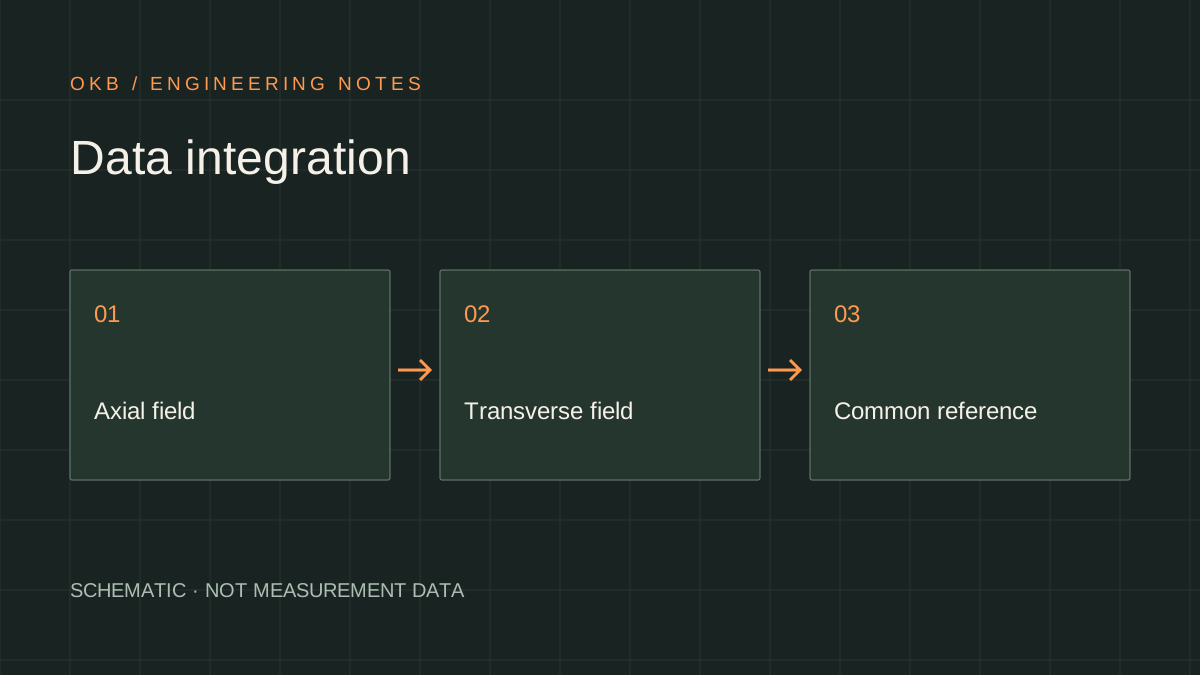
In the open annotations of the report, IP 2024 Xiang Peng, Kevin Siggers, Mark Wright and Johannes Palmer describe joint processing of MFL-A and MFL-C raw data. After pre-treatment and spatial integration, the trained model restores the metal loss profile. Magnetic measurements and laser scans were used for the training.
The authors report verification on six existing pipelines and examine both the geometry of metal loss and subsequent estimates of destructive pressure. Open annotation does not provide a complete set of errors and raw data. Therefore, the task is further reviewed in an independent engineering way: what conditions are required for the integration of measurements to produce a verifiable result?
Why Two Estimates Could Disparities
Magnetic measurements with different magnetization directions provide complementary information. The same complex anomaly can be found in these channels differently. Therefore, mechanical averageing of the two depth estimates does not necessarily bring the result closer to actual geometry.
First, we need to understand the origin of the discrepancy. Systems could divide the corrosion section differently into separate defects, register it under different conditions or use different size models. The engineering challenge is to harmonize observations, not choose a more convenient number. This requires baseline data and the conditions for their receipt.
Convergence along the path and circle
Any joint analysis starts with the question whether two signals actually belong to one place. The odometer may have local variations and the position of the measuring channels on the circle depends on the instrument orientation. Even similar images can be displaced relative to each other.
It is practical to maintain not only the conversion of coordinates but also the quality assessment of the combination. On a site with mixed directions, the algorithm should show less confidence. If automatic registration substantially distorts one data set to match another, it is necessary to check whether the actual difference is replaced by artificial harmonization.
Model learning: What to consider an independent example
Laser geometry can be a detailed description of the surface when preparing verification data. However, connect it to the magnetic signal — It's a stand-alone task. The co-ordinates, the clear boundaries of the section and how surface preparation affected the type of damage measured are needed.
A set of multiple fragments of one defect is not the same as a set of independent defects. In assessing the generalization capacity, it is important to separate objects, conditions and forms of damage. Otherwise, the model can get to know the familiar data structure but work worse on another pipeline. For engineering testing, resilience is essential on new combinations of factors, not just the total amount of learning examples.
Metal loss profile and strength calculation
The re-established surface contains more geometric information than the description of the defect in a quadrilateral. However, additional details are only useful within the confirmed reliability. A rich three-dimensional picture does not in itself mean that small falls are physically measured.
Before the profile is transferred to the calculation, it is important to agree on coordinates, units, a description of reference thickness and rules for processing missing data. It should also be understood which geometry influences the chosen calculation methodology. A local depth error and a long-term error can have different consequences; it is not enough to measure the quality of reconstruction by visual resemblance.
Uncertainties go through the entire chain
In joint processing, several sources of uncertainty have a consistent effect on the result: signal recording, combination, re-forming and further engineering calculation. They cannot be considered independent without verification. For example, a similar error of coordinates can simultaneously worsen both magnetic estimates.
It is useful to check separately the sensitivity of the result to each step. If the small permissible channel displacement dramatically changes the depth recovered, this restriction shall be visible in the documentation. If the image details exceed the confirmed spatial resolution, visualization should not give the impression of accuracy that is not available to the original data.
How to Make Results Reproducible
For re-analysis, reference channels, pre-treatment parameters, model version and reference measurements used need to be maintained. Updating the algorithm can change the estimate of the old site. This change needs to be distinguished from the physical increase in corrosion between surveys.
So the history of the object should contain a processing history. The analyst should be able to compare the results of one version of the method on different passages with those of different versions on one passage. This helps to understand the cause of the discrepancy and avoid a situation where the software improvement is interpreted as a change in pipe condition.
What this approach means for the designer of the complex
The joint processing is still in the design of the equipment. There is a need for agreed time marks, track and orientation recording, channel status information and stable data structure. The clearer the origin of each count, the easier it is to explore new methods of analysis without losing the connection to measurement.
For OKB, the interest in this area is related to the holistic design of the diagnostic system. Mechanics, electronics and software must provide verifiable input data for subsequent algorithms. For each measuring configuration, it is useful to link the requirements for the apparatus to specific verification tasks: co-ordinates, re-formation and the stability of the result when conditions change.
Engineering output
The combination of the two magnetic measurements becomes useful when a verifiable connection between signal, coordinates, reconstruction and calculation is maintained. Basic engineering criterion — Reproducibility of the result and its understandable area of credibility.
Sources and further reading
- Publicnotation of Report No. 133959, IPC 2024. The text contains the specific instructions for the wording.ROSEN / ASME IPC 2024 — Data Fusion of Complementary Axial and Circumferential Magnetic Flux Leakage Inline Inspections and Effects on Safe Remaining Life ↗
The article was originally written in Russian. It summarises the cited sources. For the original text and illustrations, consult the publications listed below.